This survey reframes the privacy challenge in federated recommendation from an architectural problem (data stays local) to a geometric one: gradient updates must be orthogonal to a sensitive subspace in the latent representation space. Building on this perspective, we organize the rapidly growing literature on Personalized Federated Foundation Models for recommendation into a unified framework, identify five open problems (semantic gap, structural rigidity, semantic heterogeneity, optimization conflict, compute and communication), and lay out five future directions that map one-to-one to those problems.
@inproceedings{li2026pffm,title={A Survey of Personalized Federated Foundation Models for Privacy-Preserving Recommendation},author={Li, Zhiwei and Long, Guodong and Zhang, Chunxu and Zhang, Honglei and Zhang, Chengqi and Jiang, Jing},booktitle={Proceedings of the 35th International Joint Conference on Artificial Intelligence (Survey Track)},year={2026},}
AAAI 2026
Federated Vision-Language-Recommendation with Personalized Fusion
Zhiwei Li, Guodong Long, Jing Jiang, and
In Proceedings of the AAAI Conference on Artificial Intelligence, 2026
FedVLR is a federated recommendation framework that integrates vision-language models with personalized fusion to address multimodal cold-start and heterogeneity. It uses adapter tuning on a frozen VLM backbone and a per-client fusion head that is trained locally, retaining global semantic priors while adapting to local taste distributions.
@inproceedings{li2026fedvlr,title={Federated Vision-Language-Recommendation with Personalized Fusion},author={Li, Zhiwei and Long, Guodong and Jiang, Jing and Zhang, Chengqi and Yang, Qiang},booktitle={Proceedings of the AAAI Conference on Artificial Intelligence},year={2026},}
2025
AAAI 2025
Personalized Federated Collaborative Filtering: A Variational AutoEncoder Approach
Zhiwei Li, Guodong Long, Tianyi Zhou, and
In Proceedings of the AAAI Conference on Artificial Intelligence, 2025
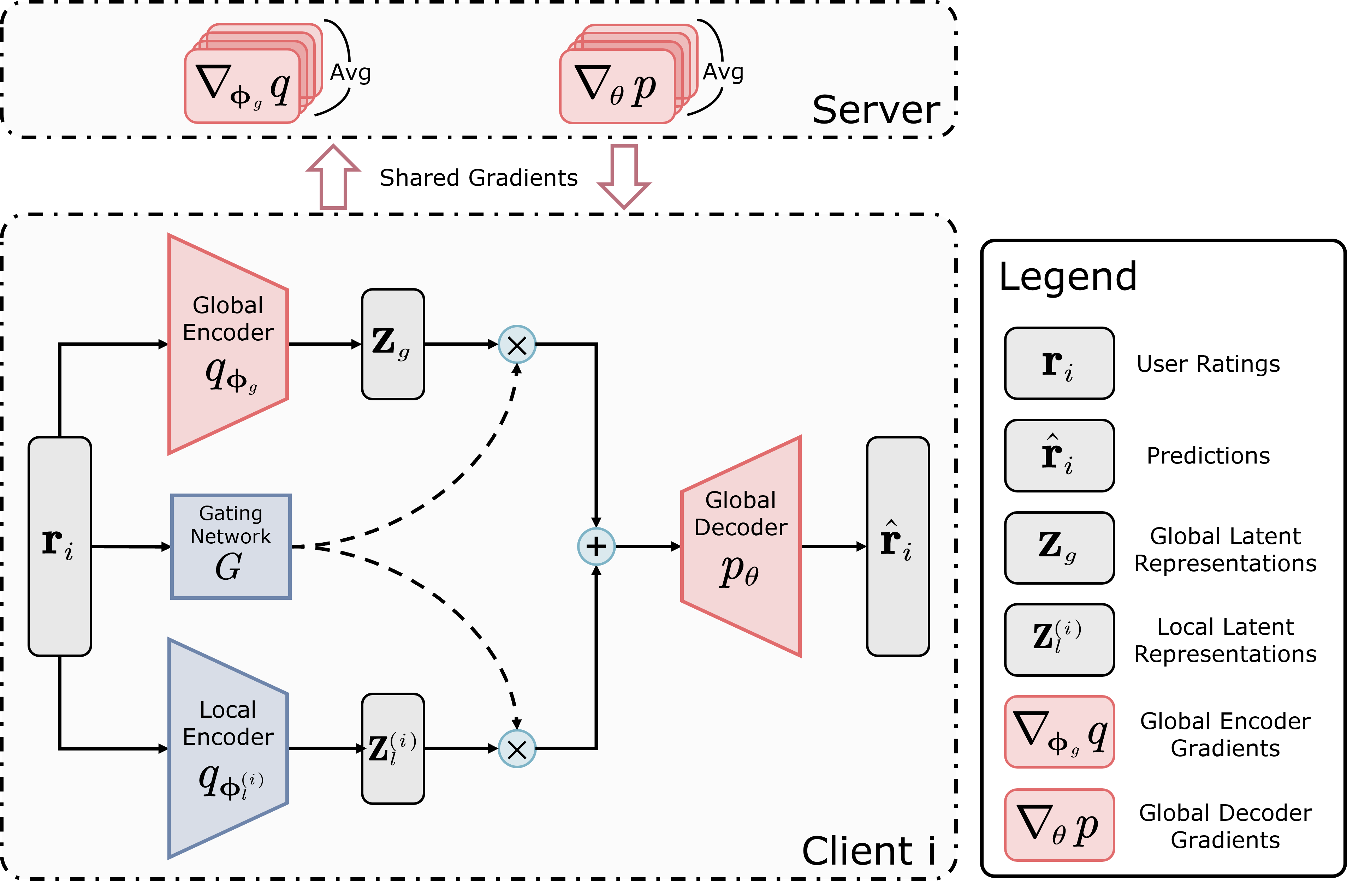
FedDAE casts personalized federated collaborative filtering as a variational autoencoder problem in which each client has its own decoder while sharing an encoder. This decomposition aligns the personalization-vs-generalization trade-off with the latent-space structure of the VAE and yields consistent gains across MovieLens, LastFM, and HetRec benchmarks.
@inproceedings{li2025feddae,title={Personalized Federated Collaborative Filtering: A Variational AutoEncoder Approach},author={Li, Zhiwei and Long, Guodong and Zhou, Tianyi and Jiang, Jing and Zhang, Chengqi},booktitle={Proceedings of the AAAI Conference on Artificial Intelligence},year={2025},}
2024
ICLR 2024
Federated Recommendation with Additive Personalization
Zhiwei Li, Guodong Long, and Tianyi Zhou
In International Conference on Learning Representations, 2024
FedRAP decomposes a recommendation model into a globally shared component and a per-client additive personalization term, regularized to be sparse so that personalization is communicated efficiently. The method delivers state-of-the-art performance on standard federated recommendation benchmarks while using a fraction of the per-round communication.
@inproceedings{li2024fedrap,title={Federated Recommendation with Additive Personalization},author={Li, Zhiwei and Long, Guodong and Zhou, Tianyi},booktitle={International Conference on Learning Representations},year={2024},}
2023
PRICAI 2023
Incomplete Multi-View Weak-Label Learning with Noisy Features and Imbalanced Labels
Zhiwei Li, Zijian Yang, Lu Sun, and
In Pacific Rim International Conference on Artificial Intelligence, 2023
NAIL is a noise-aware multi-view weak-label learning framework that handles missing views, noisy features, and class imbalance jointly. It learns a shared low-dimensional embedding plus view-specific noise estimators, and balances training via class-aware reweighting.
@inproceedings{li2023nail,title={Incomplete Multi-View Weak-Label Learning with Noisy Features and Imbalanced Labels},author={Li, Zhiwei and Yang, Zijian and Sun, Lu and Kudo, Mineichi and Kimura, Keigo},booktitle={Pacific Rim International Conference on Artificial Intelligence},year={2023},}